Most women over sixty never try yoga for one reason. And that reason is the very thing yoga fixes.
“I’m not flexible enough.” Sound familiar?
Nobody starts yoga because they are already flexible.
They start because they are stiff, tired, a little unsteady on their feet, or simply looking for something that feels good in their body again.
If any of those descriptions fit, you are exactly the right candidate.
Yoga after sixty is not about touching your toes or holding an impressive pose.
It is about showing up for your body in a way that feels gentle, consistent, and genuinely good.
And the research on what it does for women at this stage is surprising.
The Best Types of Yoga to Start With After Sixty
Not all yoga is the same.
Choosing the wrong style as a beginner is one of the fastest ways to confirm every doubt you had about it.
The good news is that the styles best suited to women over sixty are also the most welcoming and the most forgiving.
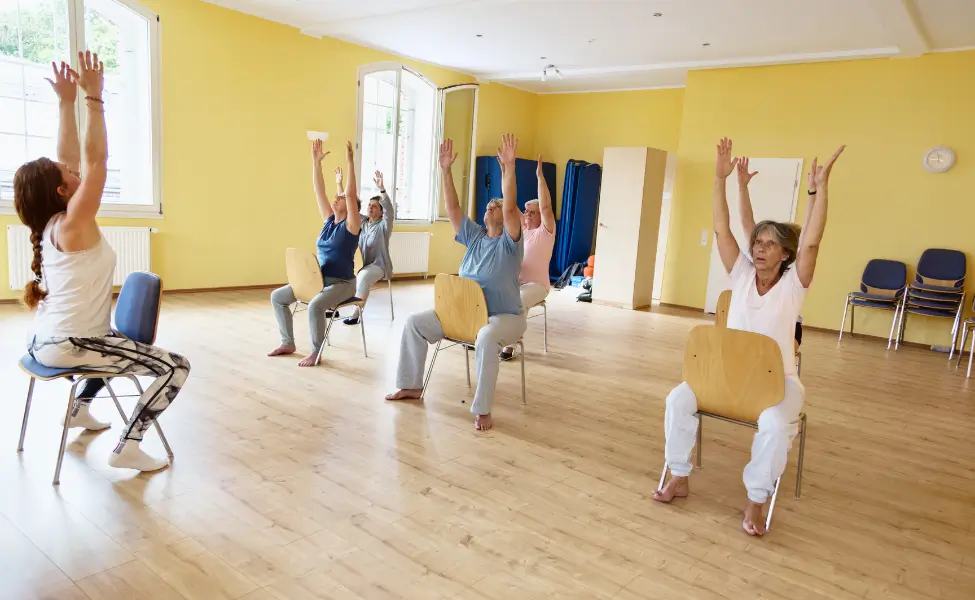
Here are the types worth starting with:
- Chair yoga. Every pose is done seated or using a chair for support. There is no getting up and down from the floor, no balance required, and no prior experience needed. Harvard Health confirms that chair yoga delivers real benefits for strength, flexibility, and balance with no risk of falling, making it one of the safest starting points available. If you are uncertain about your mobility or have any joint concerns, this is where to begin.
- Restorative yoga. Slow, supported poses held for several minutes at a time. You use props like bolsters, blankets, and blocks to fully support your body. The focus is on releasing tension and calming the nervous system. It feels less like exercise and more like being given permission to rest deeply.
- Hatha yoga. A gentle, foundational style that moves at a slower pace than most. Poses are held long enough to feel them working without rushing to the next one. Most beginner classes for older adults use a Hatha approach.
- Iyengar yoga. Known for its use of props and its focus on alignment. Chairs, blocks, and straps mean you can do every pose safely regardless of your starting flexibility. Many older adults find this style particularly trustworthy.
For finding classes, your local YMCA, community center, or senior center is often the best starting point.
Many offer classes designed specifically for older adults at lower cost.
Online platforms like YouTube also carry free beginner yoga for seniors, which lets you try before you commit to anything.
The Physical Benefits Nobody Warned You About
Yoga does more for your body after sixty than most people expect.
And most of it has nothing to do with flexibility.
A 2023 analysis of randomized controlled trials found that yoga significantly improved balance, flexibility, and muscle strength in adults aged sixty and above.
These are not small effects. Balance and strength determine how confidently you move through your day.
They decide whether you trust yourself on uneven ground, whether you feel steady reaching overhead, and whether your posture still feels like yours.
Yoga also regularly improves everyday movement.
Getting up from a chair, turning around quickly, navigating stairs.
The women in these studies were not athletes.
They were ordinary older adults who showed up to a regular yoga class and found themselves moving better within weeks.
On the question of falls, yoga reliably improves balance and reduces the fear of falling, both of which are significant risk factors.
The research on whether yoga directly reduces actual falls is still growing, and the evidence is mixed.
What is clear is that the physical qualities yoga builds—stronger legs, better balance, and more body awareness—are exactly the ones that keep you stable and confident on your feet.
If you want to pair yoga with a few targeted moves that work the same muscle groups, these five gentle morning moves complement a yoga practice beautifully and take less than ten minutes.
But the benefits do not stop at your body.
How Yoga Sharpens Your Mind and Calms Your Nerves
What if the hour you spend on a yoga mat also made you sharper for the rest of the day?
A review of six randomized trials found that four out of six reported meaningful positive effects on memory and sharp thinking in healthy older adults.
Yoga that includes breathwork and mindfulness appears particularly promising for supporting mental clarity, with several studies showing improvements in the kind of focused thinking that can feel harder to access as we get older.
The stress reduction effects are among the best-supported findings in the research.
A review published by Harvard Health found that yoga was the most effective relaxation technique for both depression and anxiety in older adults and appeared to provide the longest-lasting effect of all the approaches studied.
Slow, deliberate breathing activates the part of your body that creates calm, and this effect is there from the very first class.
You do not need months of practice to feel it.
Mindfulness is woven into every yoga session. For women who spend a lot of time in their heads, planning, remembering, and second-guessing, that shift into the body can feel like a genuine relief.
Yoga fits naturally alongside other small daily habits that support your energy and mood.
These simple morning habits are a good place to see how movement and routine work together.
There is one more thing most yoga articles skip over entirely.
The Social Side of Yoga That Changes Everything
Has your world felt a little quieter since retirement?
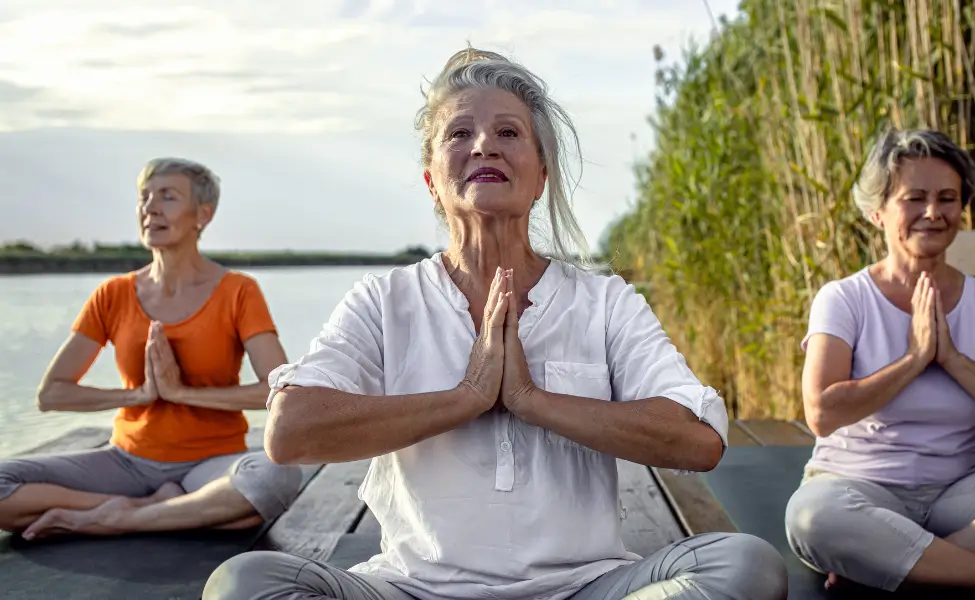
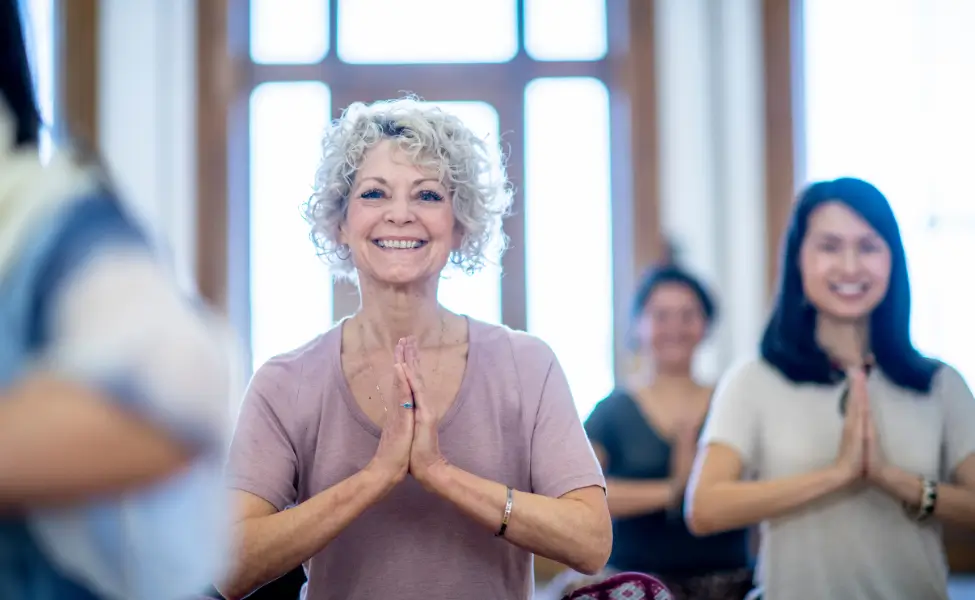
Yoga classes create a particular kind of community.
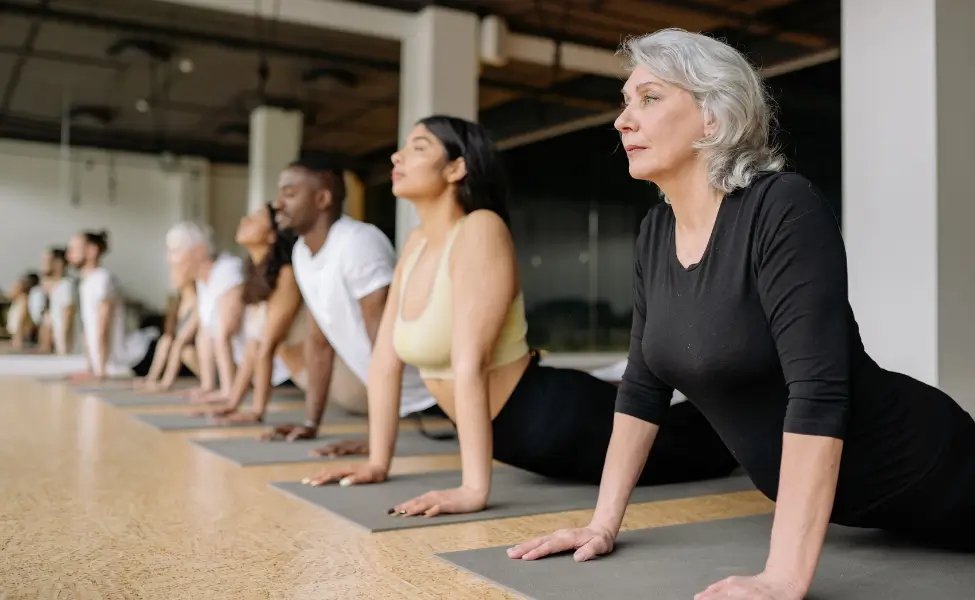
You are all in the same room, moving through the same challenges, at roughly the same pace. Nobody is performing for anyone else.
The atmosphere in a good class for older adults tends to be warm, unhurried, and genuinely supportive in a way that a gym or a fitness class rarely is.
For women who have found their social world getting a little quieter since retirement or since the children left, this matters more than it sounds.
Research confirms that yoga reduces depressive symptoms and improves mood in older adults.
Part of that effect almost certainly comes from the simple experience of being in a room with other people doing something good for themselves together.
Yoga trains you to notice what your body feels without rushing to react.
That skill quietly changes how you handle stress outside the class too.
If you are looking for other activities that lift your mood and keep you moving without feeling like exercise, these nine simple hobbies are worth a look.
How to Take Your First Step Without Overthinking It
If you have been on the fence about this, the most useful thing you can do is find one class and go once.
Not to decide whether yoga is for you. Just to see what it feels like to show up.
Chair yoga is the place to start if mobility is a concern.
A beginner Hatha class is the place to start if you want to try standing poses with plenty of support.
Online classes are a reasonable option if you want to try something privately before walking into a room full of strangers.
Wear comfortable clothes you can move in.
Arrive a few minutes early and let the teacher know you are new and what physical considerations they should know about.
A good teacher will offer modifications for every pose without drawing attention to them.
You are not trying to become a yoga person overnight.
You are trying one class to see whether this is something your body enjoys.
That is a very small ask for something that might turn out to matter quite a lot.
Start moving more regularly and you will find yourself reaching for food that matches how good you feel.
The two habits pull each other forward.
If you want simple, nourishing meals that give your body the energy to keep showing up, my Mediterranean-inspired meal planner was built for exactly that.