

You eat reasonably well.
You move when you can.
You have read the articles, tried the programs, and done your honest best.
So why does it still feel so hard?
If you are in your sixties and have quietly started to wonder whether your body simply does not work the way it used to, you are not imagining it.
The rules genuinely changed.
What worked in your forties does not always work now, and following advice written for women twenty years younger often leaves you feeling like the problem is you.
It is not.
The advice was wrong for where you are, and the sooner that lands, the sooner things start to shift.
Most health content focuses entirely on what you eat and how much you move.
Almost none of it mentions the one factor that shapes your hunger, your energy, and your ability to make good choices more than food ever could.
That factor is pace.
The speed and awareness with which you move through your day has a direct and measurable effect on your hormones, your appetite, and your weight.
That is what slow living is really about, and it is one of the most practical changes a woman over sixty can make.
Why Your Body Is Not Broken, Just Running on the Wrong Instructions
After menopause, estrogen drops significantly.
That shift matters for more than hot flashes and sleep.
Estrogen normally helps regulate how your body responds to cortisol, the hormone your system releases under stress or pressure.
When estrogen declines, cortisol’s effects become more pronounced.
Visceral fat cells, the deep abdominal fat that so many women in their sixties find frustrating, contain more cortisol receptors than fat stored elsewhere in the body.
When cortisol is regularly elevated, those receptors signal the body to store more fat precisely where you least want it.
This is not a willpower problem.
Your metabolism has not simply given up.
Your body is responding logically to a set of hormonal conditions that no amount of calorie counting addresses directly.
The approach most women try, tracking, restricting, and pushing harder, creates its own pressure on the body and can raise cortisol further.
That is why it works for three weeks and then stops.
That is why you lose a few pounds and then gain them back the moment life gets complicated.
The method was fighting your biology, not working with it.
Understanding this one mechanism will not fix everything.
But it does mean you can stop blaming yourself for outcomes that were never fully in your control.
What Slow Living Actually Means in Practice
Slow living is not a retreat from real life.
It does not ask you to spend hours in the kitchen, follow a new set of rules, or add another structured routine to your day.
It is the practice of bringing a little more awareness to things you are already doing.
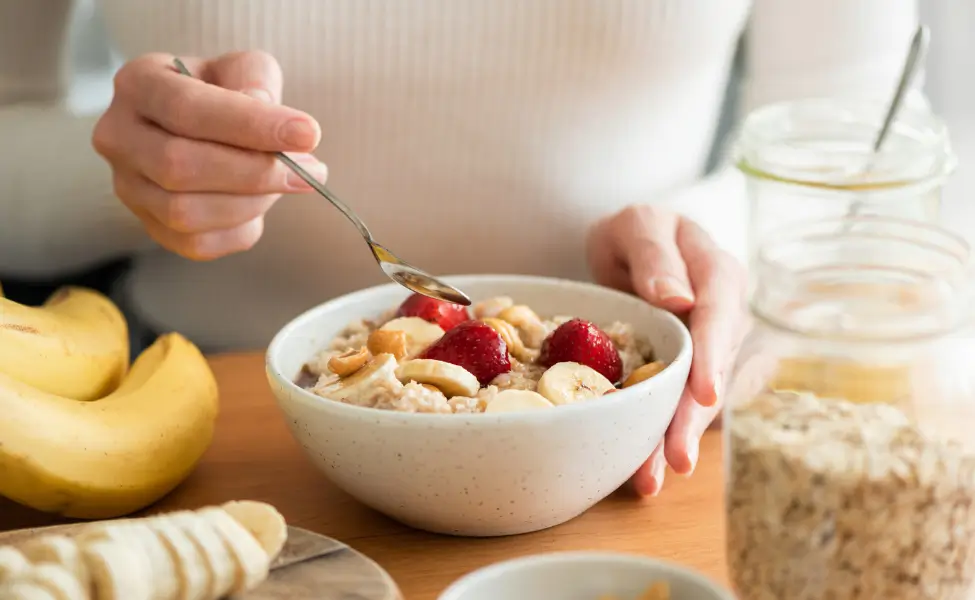
For a woman over sixty who wants to feel better in her body without fighting it, that looks like this:
- Eating meals without rushing or distraction
- Noticing when you are genuinely full rather than eating past the point of comfort
- Choosing food from a calm place rather than grabbing whatever is closest when hunger peaks
- Moving in ways that feel good rather than punishing
- Taking small, quiet pauses through the day rather than running on empty until you crash
That is the whole framework.
Nothing extreme.
No equipment, no gym membership, and no expert knowledge you do not already have.
The reason it works is not because the individual steps are impressive.
It is because each one reduces the low-level pressure your nervous system carries through the day, and that reduction has a direct effect on your hormones.
The Cortisol Loop You Might Not Know You Are In
When your days feel hurried or fragmented, even when nothing dramatic is actually happening, your body responds in a specific way.
Cortisol rises.
In that state, your body shifts into a mild protective mode.
It holds onto fat more readily, particularly around your abdomen.
It pushes you toward sugar and quick energy.
Calm, considered choices feel harder than they should, not because you lack discipline, but because your nervous system is reading your pace as pressure.
You may recognize this as reaching for something sweet in the afternoon without really meaning to, or finishing a full meal and still feeling oddly unsatisfied.
That is not a character flaw.
It is a physiological response that becomes more pronounced after menopause, when declining estrogen reduces your body’s natural buffer against cortisol’s effects.
The good news is that this loop runs in both directions.
When the pressure eases, cortisol drops.
Appetite regulation returns to something closer to its natural rhythm.
Cravings ease, not because you are restricting yourself, but because your body is no longer operating in a low-level state of alarm.
Better choices begin to happen with less effort, and that is a very different experience from whiteknuckling your way through another week of a diet.
How Eating More Slowly Changes What Your Body Does
Here is something most diet advice ignores.
Your body’s fullness signals take time to reach your brain.
The process involves gut hormones, stretch receptors, and signals traveling through the nervous system, and the whole sequence takes roughly fifteen to twenty minutes from the point at which your body has had enough food.
If you finish a meal in ten minutes while distracted or rushing, your brain has not yet received the information it needs. So you feel hungry even when your body is satisfied.
Slowing your meals does not require a ritual or a new technique.
It means putting your fork down between bites occasionally.
It means eating away from a screen at least once during the day.
It means taking one deliberate breath before you start.
Small as that sounds, it gives your body the time it needs to do what it is designed to do.
Women who make this shift often find they feel satisfied with less food, not because they are eating less on principle, but because they are finally getting the signal.
Digestion tends to improve too.
That bloated, uncomfortable feeling after meals that so many women in their sixties chalk up to age often eases noticeably when meals slow down.
Why Walking Is Doing More Than You Think
You may already walk a little.
Many women your age do, and then quietly wonder whether it is really enough.
It is more than you might think, for reasons most walking advice never mentions.
A regular walk at a comfortable pace lowers cortisol over time.
Research on women over sixty-five found that consistent walking produced significant cortisol reductions across a twelve-week period.

That matters for everything discussed in this article.
Lower cortisol means less abdominal fat retention, fewer cravings, better appetite signals, and more stable energy.
Walking also supports your cardiovascular system and helps your body manage the metabolic changes that follow menopause.
Walking is also a weight-bearing activity, which means your bones register the load and respond by slowing the natural density loss that comes with age.
It is not the most powerful single tool for bone health, but it contributes meaningfully when done consistently, and it does so without the injury risk that higher-intensity options carry.
There is something else that happens on a walk that almost nothing else replicates.
Your thoughts settle.
Your breathing slows.
The low-grade noise of the day quiets down.
If you pay attention to your surroundings while you walk, the quality of the light, the feel of the air, and the sound of your own footsteps, you engage a different part of your nervous system.
That is not a small or poetic thing.
It is a direct, biological response that reduces the same cortisol load the rest of this article is about.
The walk you were already half-considering is doing more work than you realized.
The Pause That Stops Mindless Eating Before It Starts
A significant part of eating after sixty has nothing to do with hunger.
It is driven by habit, mild boredom, low-level anxiety, or simply because the afternoon is long and food is nearby.
This is not a personal weakness. It is how the brain operates under low stimulation and quiet stress, and it becomes more common when the structure of a working week disappears.
The most effective interruption is also the simplest.
Before you reach for food outside a planned meal, pause for sixty seconds.
Not to judge yourself or run through a mental checklist.
Just to pause and notice what is actually happening.
Ask yourself whether you are genuinely hungry or whether you need something else entirely.
A short walk.
A glass of water.
Five minutes outside.
A change of room.
Sometimes the answer is still food, and that is completely fine.
But often the pause itself redirects the next ten minutes.
Over a week, those small redirections add up quietly and without the guilt and restriction that every diet eventually brings.
This Is Not the Same as Starting Over
If you are tired of approaches that start strong and fall apart by the third week, that pattern has a reason.
Diets impose rules from the outside.
They depend on ongoing willpower to function, and when life gets in the way, which it always does, the rules break down.
The self-blame follows.
And then you are back where you started, with slightly less confidence that anything will ever work.
Slow living works differently because it does not depend on willpower at all.
It builds awareness rather than compliance.
The habits are small enough that a difficult day does not undo them.
A missed walk or an unplanned meal is not a failure, because there is no fixed program to fall off.
You simply continue.
Over time, women who take this approach tend to feel full sooner without trying.
Snacking drops without force.
Energy steadies through the day.
Mood settles.
The body feels a little lighter.
Something less measurable happens too.
They start to feel like a version of themselves they actually recognize, which, if you are honest, is probably what you wanted all along.
You do not need to overhaul anything today.
Take one meal and eat it without rushing.
Take a walk and actually notice where you are.
Pause for a minute before reaching for a snack.
Any one of those is enough to begin, and beginning is all that matters right now.
Gentle Invitation
If you enjoy simple ways to eat healthier without strict dieting, you might also enjoy my 4-Week Meal Planner.
If you would like to take a look, you can explore it here.
It is designed to make healthy eating easier, with simple meals, clear structure, and no overwhelm.