
You have probably noticed it in small moments rather than one dramatic shift.
Carrying shopping bags that felt fine a year ago now tires your arms before you reach the kitchen.
Getting up from a low chair takes a little more effort than it used to.
You feel it, but nobody around you seems to think it is worth talking about.
Your doctor says your results are fine. But you do not feel fine.
And that gap between what the numbers say and how you actually feel is real, not imagined.
What is happening is not mysterious, and it is not a sign that your body has given up on you.
Your muscles are changing in a way that is completely normal after sixty and, more importantly, in a way that responds well to some genuinely simple adjustments.
Not a program. Not a gym membership.
Just a clearer understanding of what your body needs now, which is different from what it needed in your forties.
Why Your Body Feels Different Now
Muscle loss is a gradual process that begins somewhere in your thirties.
Most people lose around 3 to 5 percent of their muscle mass per decade during those earlier years, and it happens so slowly that you barely feel it.
After sixty, the rate picks up.
Without regular movement and enough of the right food, some women lose up to 8 percent of their muscle mass per decade.
Strength declines even faster than mass, which is why things that were effortless start to feel like actual effort.
The medical term for this is sarcopenia, which sounds alarming but simply means age-related muscle change.
Your body produces lower levels of the hormones that once helped build and maintain muscle, including estrogen, testosterone, and growth hormone.
Your muscles also become more resistant to protein, meaning they need more of it to get the same rebuilding effect they would have gotten easily at forty.
None of this is damage. It is biology asking for a different kind of support.
The Belief That Keeps Women Stuck
Here is something worth saying clearly, because it tends to sit quietly underneath every failed attempt at feeling better: the belief that your body is too far gone to respond.
You have probably tried things before.
A few weeks of walking every morning. A new eating approach that worked for a week.
A fitness influencer in her late thirties telling you to “just stay consistent.”
You started with genuine effort, felt no significant change, and eventually stopped.
And somewhere along the way, the story shifted from “that approach did not work” to “I am the reason it does not work.”
That story is not accurate. The approaches were wrong for your body right now, not you.
Muscle tissue at sixty responds to the right stimulus just as it did in earlier decades.
The stimulus is just different.
It is gentler in some ways, more specific in others, and far less dramatic than anything you have probably tried before.
What Your Muscles Actually Need
Two things drive muscle health after sixty: movement with some resistance and enough protein spread across your day. Everything else is secondary.
Movement that gives your muscles something to push against
Walking is genuinely good for your heart, your mood, and your joints.
But walking alone does not give your muscles the resistance signal they need to stay strong.
Your muscles need to work against something, even something small, to maintain and gradually rebuild their strength.
The good news is that this does not require equipment or a gym.
Everyday movements, done with a little intention, count as resistance work.
Standing up from a chair without using your hands is a legitimate strength exercise for your legs.
Carrying shopping bags by hand instead of using a trolley works your arms and shoulders.
Climbing one flight of stairs uses more muscle groups than most people realize.
Wall push-ups, where you place your hands flat against a wall and lean in and push back, are a safe and effective upper-body exercise you can do in your kitchen.
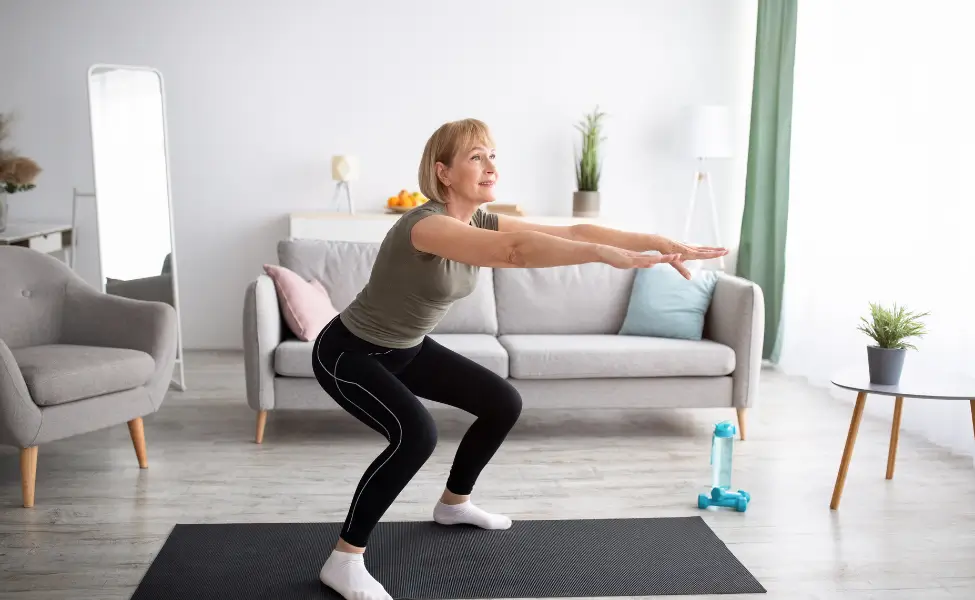
A gentle squat to a chair and back up again, repeated ten times after your morning coffee, builds leg strength in under two minutes.
Resistance bands, which cost very little and take up no space, add light challenge to movements you are already making.
None of this needs to feel hard.
A gentle, consistent effort repeated most days does more for your muscles than one intense session you dread repeating.
Protein, and why you need more of it than you think
After sixty, your muscles become less efficient at using protein.
They can still use it well, but they need a larger amount to get the same rebuilding effect.
The practical recommendation from nutrition researchers is around 25 to 30 grams of protein at each meal, spread across breakfast, lunch, and dinner rather than loaded into one sitting.
That sounds like a lot until you see what it actually looks like on a plate.
Two eggs with a slice of cheese gives you roughly 18 to 20 grams.
Add a small pot of Greek yogurt and you are at 25.
A palm-sized piece of chicken or fish at dinner covers 25 to 30 grams on its own.
A bowl of lentil soup with a piece of whole-grain bread gets you close to 20.
These are ordinary foods, not supplements or special products.
One small change that makes a real difference: add a source of protein to your breakfast.

Most women over sixty eat very little protein in the morning and concentrate it at dinner, which is the least effective pattern for muscle maintenance.
Eggs, Greek yogurt with nuts, or cottage cheese with fruit are all easy ways to shift that balance.
Your evening meal also matters more than many people realize.
Protein eaten with dinner, or as a light snack before bed, is digested and used by your muscles during sleep.
Overnight is when much of your muscle repair happens.
A dinner that includes a proper protein source is not indulgence. It is maintenance.
How Long Before You Feel a Difference
This is usually the first question, and it deserves an honest answer rather than an encouraging one.
Most women notice something within two to three weeks of adding consistent protein and gentle resistance movement.
It is not a dramatic change.
It is the absence of the usual afternoon tiredness, or realizing that the shopping bags felt lighter than they did last week, or getting out of the car without that brief moment of stiffness.
Visible strength, the kind where you feel genuinely steadier and more capable, tends to build over six to eight weeks of consistency.
Not intensity. Consistency.
Three months in, the difference is something other people start to notice, even if they cannot name exactly what has changed.
The change is real. It is just quiet at first, which is actually a good sign.
Quiet means sustainable.
The Part Nobody Talks About
Feeling tired, soft, and less like yourself is not an inevitable part of getting older.
It is a common one, because most health advice is still designed for bodies that are thirty or forty, and most women over sixty have spent years trying approaches that were never built for their situation.
Your metabolism has not broken.
Your body has not stopped listening.
What has changed is the conversation it needs you to start having with it, one that sounds less like a punishing plan and more like steady, respectful attention.
You do not need to overhaul your life.
You need to adjust two things, move a little against resistance, and eat enough protein, and repeat both often enough that your body starts to trust the pattern.
That is not a dramatic transformation.
It is just how strength actually builds after sixty.
Small, repeated actions, taken consistently, by a woman who has decided she is not done yet.
Gentle Invitation
If you enjoy simple ways to eat healthier without strict dieting, you might also enjoy my 4-Week Meal Planner.
If you would like to take a look, you can explore it here.
It is designed to make healthy eating easier, with simple meals, clear structure, and no overwhelm.