There’s a particular kind of frustration that nobody really talks about. You know movement is good for you. You’ve read the articles.
You’ve told yourself, more than once, that you’re going to start walking regularly. Maybe you even did, for a week or two.
And then life got in the way. Or your knees ached. Or you just ran out of momentum and quietly let it go, the way you’ve let a few things go lately.
If that sounds familiar, I want you to know something: the problem was never you. It was the approach.
Because the kind of walking advice that’s everywhere was mostly written for women twenty years younger.
It assumes a certain energy level, a certain body, a certain kind of daily structure that looks nothing like your life right now.
So of course it didn’t stick. It wasn’t made for where you actually are.
This is.
Why Your Body Feels Different Now (And What That Actually Means)
Before we talk about walking, let’s talk about something most wellness content skips past entirely.
Your body has changed. Not because something went wrong, and not because you stopped trying hard enough. Hormonal shifts after menopause genuinely alter the way your body manages energy, weight, and recovery.
Your metabolism works differently. Your sleep may be lighter. The things that worked in your forties no longer work the same way, and that is not a character flaw. It is biology.
Here is what matters: different does not mean stuck. Your body at sixty is still capable of meaningful, real change. Not the dramatic transformation kind.
The kind that makes you feel steadier on your feet, more awake in the morning, more comfortable in your own skin.
That kind of change responds beautifully to gentle, consistent movement, and walking is one of the most effective ways to start.
Research on women in your age group consistently shows that regular walking improves sleep quality, reduces fatigue, supports joint health, lifts mood, and helps the body manage blood sugar more effectively.
Not someday. Within weeks of starting, and even with short walks.
Your window has not closed. It just requires a different key.
Why Starting Feels Harder Than It Should
Most of us do not struggle to start because we are lazy or undisciplined. We struggle because we have been here before.
We started something, felt good for a few days, lost steam, and stopped. And somewhere in the back of our minds, that history left a quiet question: what if the problem is me?
It is not. But the approach probably was.
The most common mistake is beginning too big. Deciding to walk thirty minutes every morning, every day, starting Monday.
That plan sounds reasonable in the abstract. In practice, it creates a brittle routine that collapses the first time you sleep badly, or the weather turns, or you simply do not feel like it.
When that happens, missing one day feels like failure. And failure feels like proof of the thing we feared most.
The solution is not more willpower. It is a smaller, more honest beginning.
Step One: Start With Five Minutes and Mean It
Not five minutes as a warm-up to something bigger. Five minutes as the actual goal.
Walk to the end of your street and back. Walk once around your garden. Step outside, breathe some fresh air, and come back in. That counts. That is a real walk.
The purpose of a five-minute walk is not fitness. It is proof. You are showing yourself, in the gentlest possible way, that you can do this. That you will do this. That your body is willing.
When I first started rebuilding my own walking habit, I did not set ambitious targets. I walked to the corner and came home. Some days that felt like enough, and I let it be enough.
Other days I kept going because the movement felt good and the air smelled like something worth being outside for.

There was no plan to stick to. No distance to hit. Just one small decision to go outside and move.
Make that decision today. Then make it again tomorrow. That is genuinely all Step One requires.
Step Two: Build a Rhythm, Not a Rule
Once a few walks are behind you, the temptation is to turn them into a rigid schedule. Walk every day at eight in the morning. Never skip. Always do thirty minutes.
Rigid plans feel organized. They also fall apart the moment real life touches them, and then the guilt of breaking the rule becomes another reason to stop.
A rhythm is different from a rule. A rhythm is walking most days, in whatever window the day allows.
Morning when that feels good, afternoon when morning did not happen, evening when everything else shifted. A rhythm bends without breaking.
What matters is not perfect consistency. It is returning. Missing a walk is not failure.
Deciding the whole thing is over because you missed a walk, that is the only real failure, and it happens entirely in your head, not in your body.
Your body holds no grudge. It is always ready to begin again.
Step Three: Remove Every Obstacle You Can
Walking is genuinely simple, but we are very good at making it complicated.
We tell ourselves we need better shoes before we start. Or a walking partner. Or a route that feels safe, or weather that cooperates, or a day when we feel more energetic than usual.
Each of these conditions becomes a reason to wait, and waiting becomes a habit of its own.
Here is what you actually need: shoes that are comfortable, a door to walk out of, and five minutes.
That is the complete list.

If your knees are uncomfortable, walk slower and shorter. Your pace does not need to impress anyone, and there is no prize for pushing through pain.
Sharp or persistent joint pain is worth mentioning to your doctor, but general stiffness at the start of a walk usually eases once you are moving. Give it a few minutes before you decide how you feel.
Do not compare your walk to anyone else’s. The woman you see striding past you has her own history, her own body, and her own starting point. Yours is yours. Walk at the speed that feels honest for where you are today.
Step Four: Pay Attention to Where You Are
This is the step that changed everything for me. Not the distance I covered, not the pace I kept, but the simple act of noticing.
The way light looks through leaves at eight in the morning. The sound of a bird you cannot name but recognize from yesterday. The smell of someone’s garden after rain.
The particular quiet of a street before the day fully wakes up.
When you start paying attention to what is around you, something shifts. The walk stops being exercise you are doing and becomes a moment you are inside. The difference between those two things is enormous.
On your next walk, try this. Look up at the sky once. Listen for three separate sounds. Feel your feet meeting the ground with each step.
Not as a mindfulness exercise you read about somewhere, but just as a way of being present in a body that is doing something good.
Women who have been through the kind of life transition you are navigating often describe this kind of quiet attention as one of the first things that helped them feel like themselves again.
Not a programme. Not a transformation. Just a walk, and the willingness to actually be in it.
Step Five: Let It Grow in Its Own Time
Something happens when you walk regularly for a few weeks without pressure.
You start to look forward to it. Not every day, and not dramatically. But on the days when you do not walk, you notice the absence. Your body misses the movement. Your mind misses the quiet.
That is the habit taking root.
When that happens, you may find yourself walking a little further without planning to. Exploring a different street. Staying out an extra ten minutes because the evening light is doing something worth watching.
This is not willpower. This is momentum, and it feels completely different.
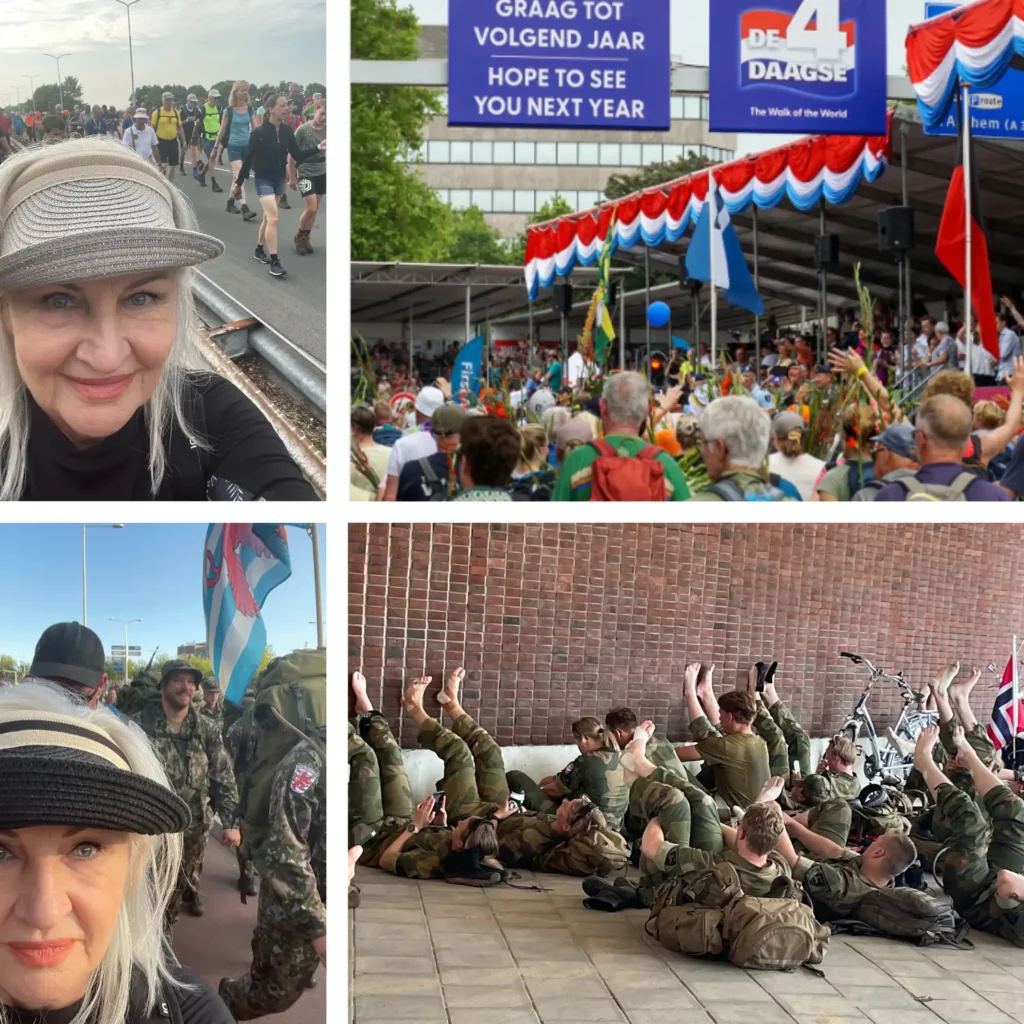
I walked five minutes around my block for the first time and told myself that was enough. Months later I was walking through the countryside for hours at a time.
In 2023, I completed the Nijmegen Four Days Marches, the world’s largest multi-day walking event, covering thirty kilometres a day across four days.
I’ve already done it three times. I hadn’t planned that. I hadn’t even imagined it at first. I just kept going outside again and again!
What to Watch Out For Along the Way
A few honest things worth keeping in mind as you find your rhythm.
- Pain is information, not weakness. General stiffness at the start of a walk is normal and usually passes. Sharp pain, or pain that gets worse as you walk, is your body asking you to stop. Listen to it.
- Rest days are not failures. They are part of the process. A body that rests recovers and comes back stronger.
- Slow results are still results. The changes that come from gentle, consistent walking build gradually. You may notice better sleep before you notice anything physical. You may feel more settled in yourself before your clothes fit differently. All of it counts.
- You do not have to earn rest. If you feel tired, rest. If a shorter walk is all you have today, that is the walk you take. The goal is to keep showing up, not to keep proving yourself.
Walking Takes Energy, and Energy Comes From Food
The more you walk, the more you notice how much your meals affect how you feel. A walk after a heavy meal can feel heavy too. A walk after something nourishing and simple can feel easy, almost effortless.
If you are building a walking habit and finding that your energy dips unpredictably, the missing piece is often food.
Not complicated nutrition rules or strict eating plans, just straightforward, nourishing meals that work with a body over sixty rather than against it.
That is exactly what I had in mind when I put together the 4-Week Meal Planner for women over sixty. Simple meals. Ingredients you already know.
No rigid rules, and nothing that requires you to overhaul how you eat from one day to the next.
Just practical, enjoyable food that helps your body feel ready to move.
If you would like to take a look, you can find it at 4 Weeks Mealplanner
You Already Know How to Do This
You have gotten through harder things than a five-minute walk.
You have navigated life changes, raised children or built a career or both, lost people you loved, and kept going. You know how to keep going.
What you may have lost, somewhere along the way, is the permission to start small without feeling like that makes it less serious.
It does not.
Every woman I have spoken to who walks consistently now started somewhere that felt almost embarrassingly modest. A few minutes. A short street. A garden path walked twice.
Start there. Start exactly where you are.
The woman you want to feel like again is not waiting at the end of a long difficult road. She is just outside your front door, five minutes from where you are standing right now.